
 Prosenjit Datta

I have followed with a lot of interest and now amusement the hysterical debates on television and social media platforms after Mr Subhash Chandra Garg, former finance secretary, pointed out in a television debate that the absolute nominal GDP figure (or GDP at current prices) for first quarter of FY26 had been revised sharply downwards – and that led to the 10.3% nominal GDP growth for first quarter of FY27, and from which number the real GDP estimates of 7.8% were derived.
The point most laymen (and IT trolls) miss is that the Indian GDP estimates are revised multiple times over two and a half years. The full-year GDP figure gets revised six times over three years before it is considered final. The quarterly GDP estimates change as better data comes in. What was released on August 31 was the first estimate of the first-quarter GDP of FY27. It will be revised and new numbers released in February next year, then again in June next year – and will keep getting revised along with the annual GDP estimates until the final annual GDP is released. Sometimes the GDP (quarterly and annually) gets revised upwards – and revised down many times as well.
This is normal practice, but the GDP can be revised even after the initial finalisation after three years if the Ministry of Statistics and Planning Implementation (Mospi) adopts a new methodology, or it changes the base year.
This is why, for any serious analysis of the economy and economic trends, the first estimates of first-quarter GDP are of limited use. And thus, in most countries, the early estimates – quarterly or annual – are treated as routine, and not much hoopla surrounds them.
India is different – and the new India post-2014 is even more different – in the circus it conducts around the routine release of economic estimates data. It is because the government loves to brag about how well it is doing in terms of GDP growth – even if there is little evidence of the growth actually trickling down to improve the lives of the poor.
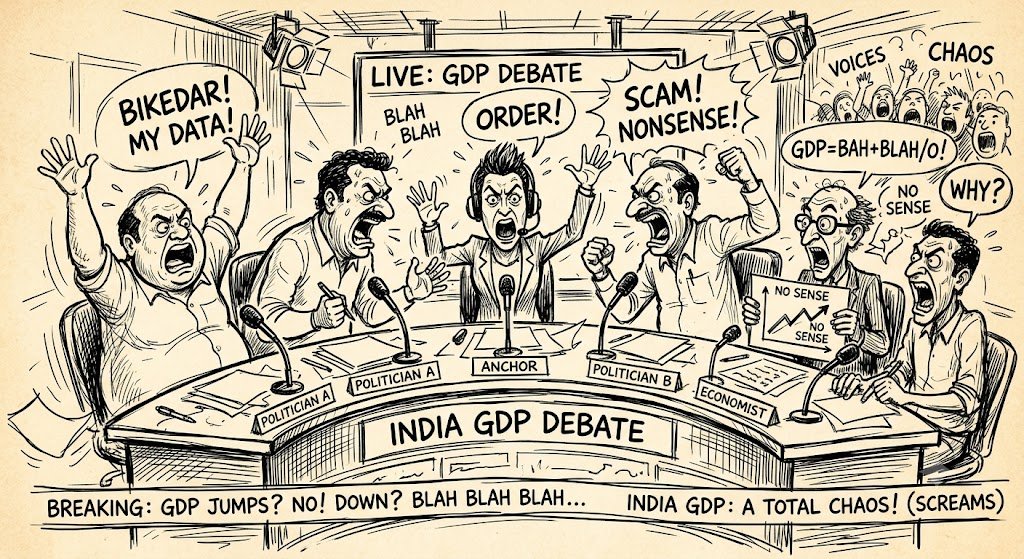
The hype and hoopla accompanying routine GDP estimates data has grown over the past few years. The release of the first estimates of the first-quarter GDP growth for FY27 was celebrated with reels, bombastic tweets, and news bites by the PM and others in the government. Television media conducted panel discussions during Prime Time on the 7.8% real GDP growth, beating all consensus estimates. Jingoistic panellists and businessmen gave bytes about India’s economic resilience despite the war between the US and Iran – and between Russia and Ukraine – and other global strife.
If the government had not made such a huge noise about its economic performance based on calculations made with partial data for just one quarter of the financial year, the whole controversy would not have cropped up.
NDTV had invited former finance secretary Subhash Chandra Garg for a discussion on the first-quarter numbers. They probably expected him to give some inconsequential sound bytes congratulating the government’s performance. Unfortunately for NDTV (and the government), Mr Garg pointed out one pertinent data point that NDTV had not looked at. The GDP at current prices (or nominal GDP) for the first quarter of FY26 had been drastically revised downwards.
When the government released the first estimates of first quarter FY26 GDP in August last year, it calculated the nominal GDP (GDP at current prices) size as Rs 86.05 lakh crore. From this, the real GDP growth was 7.8% for the first quarter of FY26.
However, this data was based on the 2011-12 base year and the old methodology of GDP estimation that the government was using. Since then, the government has adopted a new methodology and a new base year (2022-23). Base year changes for the GDP are routine, and even methodology changes take place periodically as better data sources and better calculation methods are developed for estimation of economic activity.
But over the period of one year, the first-quarter FY26 nominal GDP has undergone three further revisions – finally coming to Rs 80 lakh crore, a whopping 6 lakh crore lower than the originally estimated Rs 86.05 lakh crore.
Now, this change is not because of the base year changes – nominal GDP is estimated by taking actual data of things at prevailing prices at the time of measurement. So normally, if a product or service that you paid Rs 100 for in 2025, will not become lower just because you changed the base year for GDP calculations. You paid Rs 100 in 2025, and it does not automatically become cheaper for any statistical reason.
But when you calculate nominal GDP – which is technically the absolute value of goods and services produced during the time period – you are not measuring or capturing every good or every service. You measure some bits and then use statistics to come to the final aggregate amount utilising multiple data sources.
This was the cause of the nominal GDP being wildly overestimated last year in the first quarterly GDP estimates. And this is also the reason why, after revising it downwards, the GDP numbers released in August 31 this year looks so flattering. Our nominal GDP (GDP at current prices) according to the PIB release is Rs 88.27 lakh crore – which looks like a big rise from the current estimates of last year’s first quarter nominal GDP of Rs 80 lakh crore. But considerably less impressive if we take the initial nominal GDP first quarter FY25 number of Rs 86.05 lakh crore.
Mr Garg’s revelation immediately set off a war of words. Critics of the government picked on it gleefully to say the actual growth was barely anything and the government was committing fraud with statistics. Government defenders were immediately put to the work of rubbishing Mr Garg’s point using multiple – and often very stupid – explanations, most of which are not worth discussing in a serious economic analysis.
The critical point is that the government makes unnecessary hoopla over routine estimates based on initial, not final data. This also attracts more scrutiny on the way the estimations have been done. And any serious economist will point out multiple things that need further explanation by the government.
When the government knows that even the current numbers it has released will be revised multiple times, it should not make such much noise over them. The PM does not need to brag over calculations based on partial, initial data. He too knows these are not the real numbers, which will emerge only two or three years hence.


Very nice balanced article